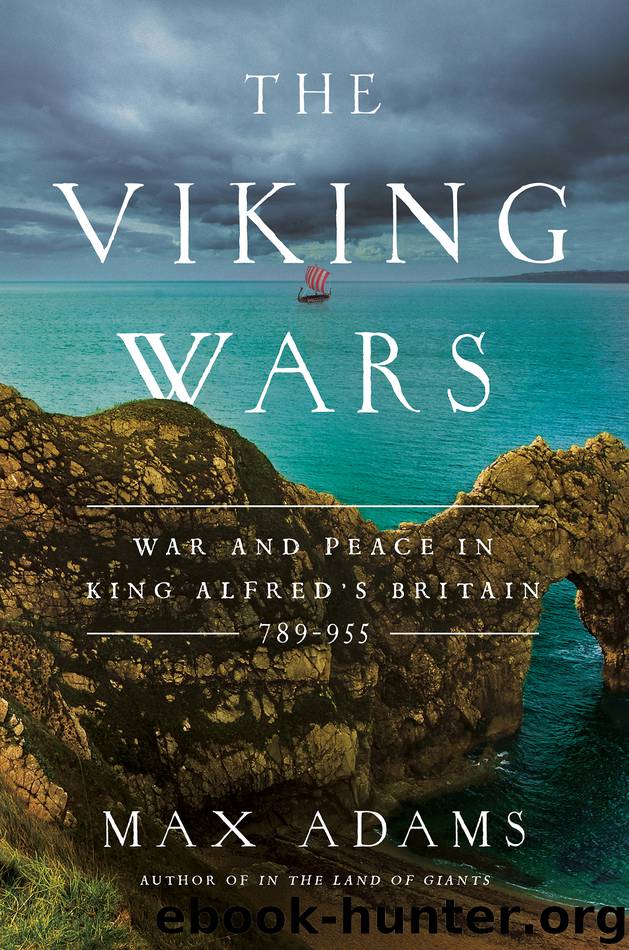
The Viking Wars by Max Adams
Author:Max Adams
Language: eng
Format: epub
Publisher: Pegasus Books
36. DUNOTTAR CASTLE, on its rocky promontory in Aberdeenshire—a target for both Norse raiders and Anglo-Saxon kings.
The first significant events in Constantín’s reign seem to reflect a series of campaigns against invading Norse from Ireland in the aftermath of their expulsion from Dublin. In 903 ‘Northmen plundered Dunkeld and all Albania’. But a year later the same Chronicle of the Kings of Alba announces that ‘Northmen were slain in Strath Erenn’‡‡‡ and a parallel record in the Annals of Ulster gives the crucial detail: ‘Ímar grandson of Ímar was slain by the men of Fortriu, and there was a great slaughter about him.’23 Ímar is the Goidelic form of the Old Norse Ívarr, the outstanding Viking dynast and scourge of the Insular kingdoms in the 860s.
Constantín was able to draw almost immediate political capital from this victory:
In the vi year§§§ king Constantín and Bishop Cellach pledged to keep the laws and disciplines of the faith and the rights of the church and the gospels, pariter cum Scottis on the Hill of Belief next to the royal civitas of Scone.24
The wording is reminiscent, as Alex Woolf points out, of the Anglo-Saxon Chronicle account of the meeting between King Ecgberht and Archbishop Ceolnoth at Kingston in 838; so too is the location, on a royal estate at the tidal head of the River Tay. This was a state occasion, the promulgation of formal relations between church and king, mutually reinforcing legitimacy, rights of patronage and law-making. Each party had aligned its immense powers of patronage with the other. It must be seen, too, as an act of Christian solidarity in the face of overtly pagan military threats, backed by the authority of Colm Cille, St Columba, whose precious relics lay higher up Strathtay at Dunkeld. The future of the Scottish state lay in the south-east, not in exposed Argyll or Fortriu. The tricky phrase pariter cum Scottis has caused much debate among historians. Alex Woolf concludes that it should best be translated ‘in the fashion of the Gaels’: that is, following precedents set anciently in Argyll between the kings of Dál Riata and the abbot-bishops of Iona.25 Alba was a Gaelic rather than a Pictish kingdom.
Even more obscure undercurrents swirling beneath the still waters of its opening decade warn us that the apparently inexorable emergence of three long-lasting polities in England, Scotland and Wales during the tenth century is a simplistic retro-fit. There is nothing inevitable about unification; Britain in the eighth and ninth centuries was intensely regional, not much less so in the tenth. Elements of the old Heptarchy,¶¶¶ even of smaller regional polities and territorial rivalries, continued to surface during the period when the great dynasts of Wessex, Gwynedd and Alba were rewriting, or suppressing, alternative histories. Under scrutiny the apparently neat façade of national identity shows structural cracks.
To begin with, Constantín could not lay claim to overlordship of the whole of what we call Scotland. Cait (Caithness) seems to have lain entirely outside his control. The Northern and Western Isles belonged to a Norse thalassocracy.
Download
This site does not store any files on its server. We only index and link to content provided by other sites. Please contact the content providers to delete copyright contents if any and email us, we'll remove relevant links or contents immediately.
| Africa | Americas |
| Arctic & Antarctica | Asia |
| Australia & Oceania | Europe |
| Middle East | Russia |
| United States | World |
| Ancient Civilizations | Military |
| Historical Study & Educational Resources |
Room 212 by Kate Stewart(5119)
The Crown by Robert Lacey(4814)
Endurance: Shackleton's Incredible Voyage by Alfred Lansing(4781)
The Iron Duke by The Iron Duke(4354)
The Rape of Nanking by Iris Chang(4211)
Joan of Arc by Mary Gordon(4109)
Killing England by Bill O'Reilly(4001)
Say Nothing by Patrick Radden Keefe(3984)
I'll Give You the Sun by Jandy Nelson(3447)
Shadow of Night by Deborah Harkness(3367)
Hitler's Monsters by Eric Kurlander(3342)
Mary, Queen of Scots, and the Murder of Lord Darnley by Alison Weir(3210)
Blood and Sand by Alex Von Tunzelmann(3203)
Eleanor & Park by Rainbow Rowell(3172)
Darkest Hour by Anthony McCarten(3133)
Margaret Thatcher: The Autobiography by Thatcher Margaret(3082)
Book of Life by Deborah Harkness(2938)
Red Famine: Stalin's War on Ukraine by Anne Applebaum(2933)
The One Memory of Flora Banks by Emily Barr(2863)
